Sunday, September 20, 2026 11:51:30

High above the surface of the Earth, beyond the visible atmosphere and far from everyday human perception, an invisible magnetic environment continuously evolves. Geomagnetic activity and magnetic storms are expressions of this dynamic system, shaped by the interaction between the Sun and the Earth. From a scientific perspective, these phenomena represent complex plasma-physical and electromagnetic processes that link solar activity with near-Earth space. They are governed by well-defined physical laws, yet their manifestations remain subtle and often unnoticed by the general population.
Geomagnetic activity is not episodic chaos but a structured response of Earth’s magnetic field to external energy input. Magnetic storms, in turn, are intensified phases of this response, marked by measurable global changes in magnetic field strength, ionospheric currents, and particle populations in the magnetosphere.
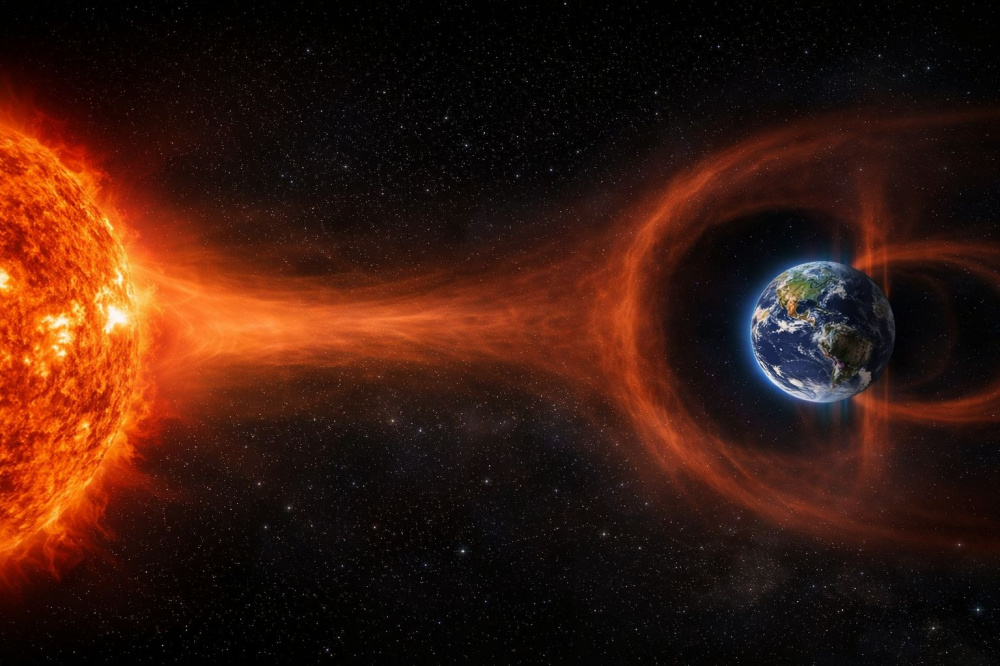
Geomagnetic activity refers to temporal variations in the Earth’s magnetic field driven primarily by solar wind interactions. The Earth’s magnetosphere acts as a protective cavity carved out of the solar wind, shaped by the balance between solar plasma pressure and the planet’s intrinsic magnetic field.
From a scientific standpoint, geomagnetic activity arises when fluctuations in solar wind velocity, density, or magnetic orientation enhance the transfer of energy into the magnetosphere. This energy is redistributed through magnetospheric currents and ultimately dissipated in the ionosphere and upper atmosphere.
Key physical components of geomagnetic activity include
Magnetopause compression and expansion
Ring current intensification
Auroral electrojet enhancement
Ionospheric conductivity changes
The Earth’s magnetic field is not static; it is a responsive system shaped by constant solar influence.
These processes are quantified using geomagnetic indices, such as Kp and Dst, which allow scientists to classify the intensity and spatial extent of magnetic disturbances.
The Sun serves as the fundamental energy source driving geomagnetic variability. Its magnetic field undergoes continuous reconfiguration, producing eruptive events that release enormous quantities of energy and plasma into interplanetary space.
Scientifically, the most influential solar drivers of geomagnetic activity are transient and recurrent phenomena
Solar flares producing electromagnetic radiation
Coronal mass ejections transporting magnetized plasma
High-speed solar wind streams from coronal holes
Interplanetary magnetic field sector changes
The geoeffectiveness of these events depends not only on their intensity but also on the orientation of their embedded magnetic fields. A southward-oriented interplanetary magnetic field enables efficient magnetic reconnection at the dayside magnetopause, significantly increasing energy transfer into Earth’s magnetosphere.
Magnetic storms represent large-scale disturbances of the magnetosphere resulting from sustained and efficient solar wind coupling. Scientifically, a magnetic storm is characterized by the development of an enhanced ring current, composed primarily of energetic ions and electrons trapped in Earth’s magnetic field.
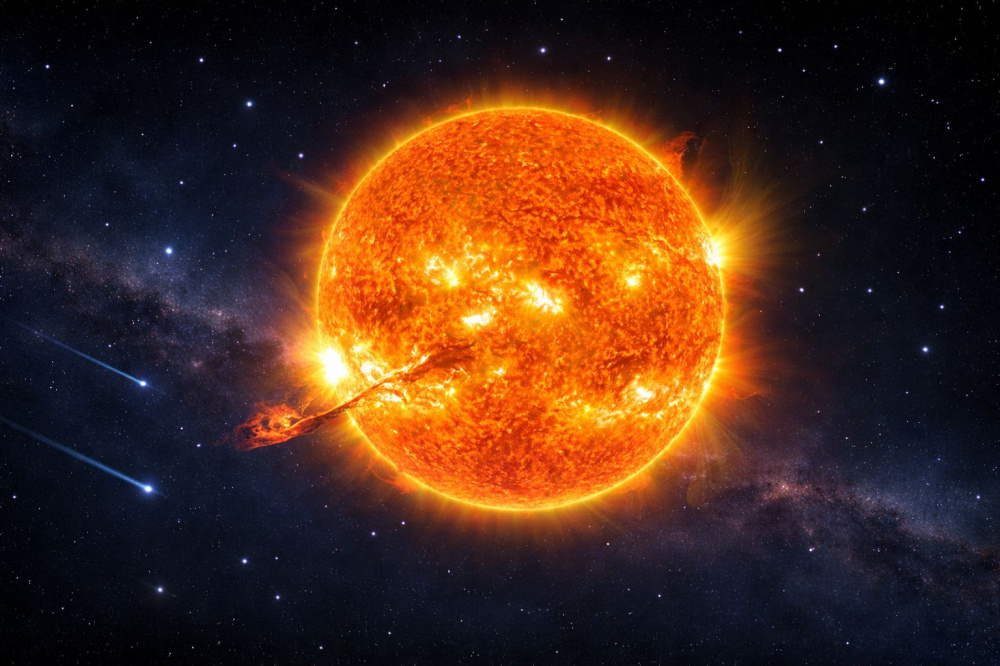
This ring current generates a global decrease in the horizontal component of the magnetic field, observable at ground-based observatories worldwide. The magnitude of this decrease defines storm intensity and duration.
During magnetic storms, several interconnected processes occur simultaneously
Injection of energetic particles into the inner magnetosphere
Strengthening of magnetospheric current systems
Expansion of auroral zones toward lower latitudes
Increased ionospheric heating and density redistribution
Magnetic storms demonstrate how solar energy can reorganize Earth’s magnetic environment on a planetary scale.
These events are studied using both in-situ satellite measurements and ground-based magnetometer networks, allowing detailed reconstruction of storm evolution.
From a scientific perspective, magnetic storms exhibit a well-defined temporal structure. Each storm progresses through distinct phases governed by plasma dynamics and energy dissipation mechanisms.
The storm evolution typically follows
Initial phase marked by magnetospheric compression
Main phase characterized by rapid ring current growth
Recovery phase involving particle loss and current decay
Post-storm relaxation of magnetic field conditions
Storm duration depends on solar wind driving conditions and internal magnetospheric processes such as charge exchange, wave-particle interactions, and particle precipitation into the atmosphere.
Geomagnetic activity directly interacts with modern technological systems through electromagnetic induction and ionospheric modification. From an engineering perspective, these interactions introduce space weather as a critical environmental factor.
Rapid magnetic field variations induce electric currents in long conductors such as power transmission lines, pipelines, and communication cables. Simultaneously, ionospheric disturbances affect radio wave propagation and satellite signal integrity.
Documented technological effects include
Geomagnetically induced currents in power grids
Satellite surface charging and deep dielectric charging
GPS signal scintillation and timing errors
Radio frequency absorption at high latitudes
These effects are well-understood within space physics and electrical engineering frameworks, allowing risk mitigation strategies to be developed.
High-altitude aviation and space-based assets operate directly within regions influenced by geomagnetic activity. Scientifically, these environments are subject to enhanced radiation levels and plasma variability during magnetic storms.
Operational responses are guided by continuous monitoring of space weather conditions
Adjustment of polar flight routes
Radiation exposure assessment for crew and passengers
Satellite anomaly prevention procedures
Dynamic frequency management for communication systems
In technologically advanced societies, geomagnetic activity has become an operational parameter rather than a theoretical concern.
This integration of space weather data into decision-making reflects the maturity of geomagnetic science.
The potential influence of geomagnetic activity on biological systems remains an active area of interdisciplinary research. While the human body is shielded from direct solar radiation by the atmosphere, it exists within Earth’s magnetic field and responds to electromagnetic stimuli.
From a scientific viewpoint, proposed mechanisms include modulation of neuroelectrical activity, alterations in melatonin secretion, and indirect effects mediated by circadian rhythm disruption.
Reported physiological and psychological responses include
Changes in sleep architecture
Variations in cognitive performance
Fluctuations in autonomic nervous system balance
Altered stress response patterns
These effects are subtle and population-dependent, requiring large datasets and controlled studies to isolate geomagnetic influences from confounding factors.
Research approaches to human sensitivity integrate physics, neuroscience, and chronobiology
Magnetoreception hypotheses
Brain wave coherence modulation models
Neuroendocrine response analysis
Psychophysiological adaptation frameworks
The interaction between geomagnetic variability and human biology remains complex, subtle, and scientifically intriguing.
While definitive conclusions are still developing, the growing body of research highlights the interconnectedness of environmental and biological systems.
Geomagnetic monitoring relies on a global network of satellites, magnetometers, and ionospheric sensors. Scientifically, this infrastructure enables real-time assessment of solar wind conditions and magnetospheric response.
Data assimilation and numerical modeling play a central role in transforming observations into forecasts. Magnetohydrodynamic models simulate plasma behavior, while empirical models provide statistical storm predictions.
Key monitoring components include
Solar imaging and spectroscopy
Interplanetary magnetic field measurements
Ground-based magnetic observatories
Ionospheric total electron content mapping
These systems allow early warnings that support technological resilience.
Scientific progress continues to refine geomagnetic forecasting capabilities. Advances in computational power and data integration promise higher accuracy and longer lead times.
Emerging directions include
Machine learning–based prediction systems
Multi-point solar wind observation missions
Coupled magnetosphere–ionosphere models
Public-facing space weather information platforms
As understanding deepens, geomagnetic activity is increasingly recognized as a fundamental component of Earth’s space environment.
Geomagnetic activity and magnetic storms illustrate that Earth exists within a complex and dynamic cosmic system. Though invisible, magnetic disturbances shape technological performance, atmospheric behavior, and potentially biological processes.
From a scientific perspective, these phenomena are not anomalies but natural expressions of solar–terrestrial coupling. Beneath the familiar blue sky lies another domain — an invisible magnetic sky, governed by physics, constantly evolving, and profoundly connected to the Sun.