
An invisible tempest over the sunshine city
San Diego, a jewel of Southern California, is synonymous with perpetual sunshine, pristine beaches, and a laid-back lifestyle. Its azure skies typically host soaring pelicans and vibrant sunsets, rarely hinting at the dramatic, unseen forces at play in the cosmos. Yet, even this idyllic setting is not entirely immune to the grand, ethereal dance of our sun's solar activity, manifesting as what we commonly call magnetic storms. These powerful, transient disturbances in Earth's magnetosphere, born from solar flares and coronal mass ejections, can extend their reach across millions of miles, eventually brushing against our planet with profound implications. For a city as technologically advanced and interconnected as San Diego, understanding these cosmic ripples is not just a matter of scientific curiosity, but of practical preparedness.
The silent symphony from the sun
At the heart of every magnetic storm lies the sun, our life-giving star, which is also a volatile powerhouse of plasma and magnetic fields. When these fields twist, snap, and reconnect, they unleash tremendous bursts of energy in the form of solar flares, or hurl massive clouds of superheated particles-coronal mass ejections (CMEs)-into space. When these CMEs are directed toward Earth, they travel at incredible speeds, sometimes reaching our planet in just a day or two. Upon impact, they collide with Earth's protective magnetosphere, compressing and distorting it, creating a cascade of effects that ripple down to the surface.
Understanding geomagnetic disturbances
Geomagnetic disturbances are categorized by their intensity, measured by scales like the K-index or G-scale. These storms can range from minor events, barely noticed, to extreme occurrences capable of widespread disruption. The interaction of solar wind particles with Earth's magnetic field generates intense electric currents in the ionosphere and magnetosphere, inducing ground currents that can infiltrate our intricate technological networks. This invisible assault is a testament to the interconnectedness of our solar system, where a distant solar eruption can trigger tangible consequences right here in San Diego.
San Diego's unique vulnerability
While magnetic storms affect the entire globe, San Diego's specific characteristics lend it a unique set of vulnerabilities and considerations. As a sprawling metropolis with a significant military presence, a burgeoning tech sector, and a reliance on complex infrastructure, the city stands at a fascinating intersection of natural beauty and advanced human endeavor. The very features that make San Diego modern and comfortable also make it susceptible to the less visible threats emanating from space.
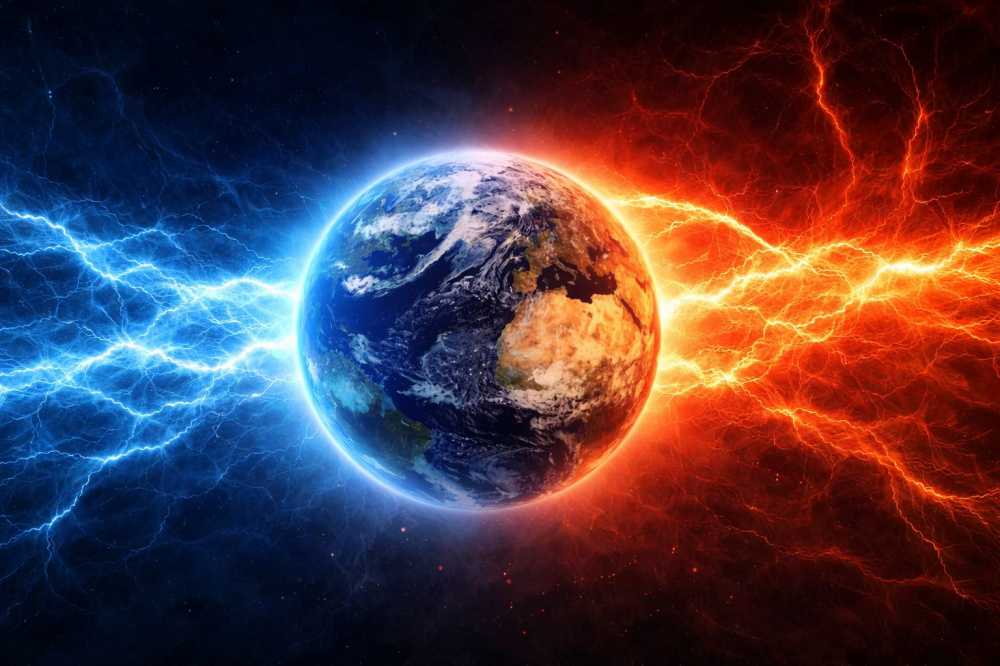
Impact on critical infrastructure
One of the most concerning aspects of strong magnetic storms is their potential to disrupt critical infrastructure. Power grids are particularly vulnerable to geomagnetically induced currents (GICs). These currents can flow through long transmission lines, overloading transformers and potentially leading to widespread blackouts. San Diego, with its dense urban areas and extensive power network, would face significant challenges in such a scenario.
The sun's temper tantrums remind us that our most sophisticated technologies are ultimately tethered to the vast, unpredictable dynamics of space.
Disruptions to navigation and communication
The accuracy of GPS systems, vital for everything from ride-sharing apps to military navigation, can be severely degraded during a magnetic storm. The ionosphere, through which GPS signals must pass, becomes turbulent and unpredictable, causing delays and errors. Similarly, high-frequency radio communications, essential for aviation, emergency services, and maritime operations along San Diego's extensive coastline, can be jammed or completely cut off. This invisible interference poses a genuine threat to operational continuity and public safety.
Influence on daily life and economy
Beyond the immediate technological failures, a severe magnetic storm could ripple through daily life. Imagine traffic lights malfunctioning, internet services slowing to a crawl, or even banking systems experiencing delays. For a city heavily reliant on tourism and logistics, such disruptions could have significant economic repercussions, impacting everything from port operations to the daily commute of millions.
Interesting facts about magnetic storms and their reach
- The strongest recorded magnetic storm, known as the Carrington Event of 1859, caused telegraph systems to fail, gave operators electric shocks, and even set telegraph papers on fire. It produced auroras visible as far south as the Caribbean.
- While auroras are usually seen at high latitudes, exceptionally strong magnetic storms can push the auroral oval equatorward, making it theoretically possible, though extremely rare, for a faint glow to be observed near San Diego's latitude.
- Geomagnetic storms can accelerate particles to very high energies, creating radiation hazards for astronauts and spacecraft, and even for high-altitude flights.
- Birds and other animals that navigate using Earth's magnetic field can become disoriented during intense storms, potentially affecting their migration patterns.
- The impact of a major magnetic storm could cost trillions of dollars globally due to infrastructure damage and economic disruption, highlighting the importance of space weather forecasting.
Preparing for the cosmic tide
While we cannot prevent magnetic storms, we can certainly prepare for their effects. Scientists and engineers are continuously working on improving space weather forecasting models, allowing for earlier warnings of impending solar events. Utilities are investing in hardening their power grids, developing protocols for isolating vulnerable components, and implementing technologies to mitigate GICs. For communication networks and GPS providers, developing redundant systems and alternative navigation methods is crucial.
Local initiatives and awareness
In a city like San Diego, public awareness plays a vital role. Educating residents and businesses about the potential impacts of space weather encourages a proactive stance. Emergency management agencies often incorporate space weather scenarios into their planning, ensuring that the city is ready to respond to a range of potential disruptions, from minor inconveniences to more severe, widespread outages.
Technological resilience in a connected world
San Diego's numerous research institutions and technological firms are at the forefront of innovation that could enhance resilience against space weather. From developing more robust satellite technologies to exploring novel ways to protect electronic systems, the spirit of ingenuity thrives. The challenge lies in translating cutting-edge research into practical, city-wide protective measures, ensuring that San Diego remains a beacon of progress, even when faced with the grand, unseen forces of the universe.