
Raleigh, North Carolina, a city renowned for its blossoming tech scene, prestigious universities, and vibrant cultural landscape, often feels insulated from the more dramatic phenomena of the natural world. Its inland position, far from coastal storms and seismic fault lines, fosters a sense of grounded stability. Yet, an invisible, often silent force, originating millions of miles away at the heart of our solar system, poses a subtle but significant threat to the very technological sinews that define modern Raleigh: magnetic storms.
These aren't storms in the conventional sense, involving wind and rain. Instead, magnetic storms, or geomagnetic storms, are profound disturbances in Earth's magnetosphere, triggered by energetic outbursts from the sun. For Raleigh, a city deeply integrated into the digital age, these celestial events translate into potential vulnerabilities for its power grid, communication networks, and GPS systems. Understanding this unseen cosmic dance and its terrestrial repercussions is crucial for the resilience of the Capital City.
Understanding magnetic storms
The story of a magnetic storm begins with the sun, a fiery leviathan whose surface is a maelstrom of activity. Our star constantly emits a stream of charged particles known as the solar wind. However, sometimes, this activity intensifies dramatically, leading to the birth of a geomagnetic storm.
The sun's tumultuous ballet
The primary instigators of major magnetic storms are solar flares and Coronal Mass Ejections (CMEs). Solar flares are sudden, intense bursts of radiation emanating from the sun's surface, often associated with sunspots – cooler, darker regions where magnetic field lines are particularly tangled. While flares travel at the speed of light, their direct impact on Earth is primarily through radio and X-ray radiation, which can disrupt high-frequency radio communications.
CMEs, however, are the true giants of space weather. These are colossal expulsions of plasma and magnetic field from the sun's corona, weighing billions of tons, hurtling through space at speeds ranging from a few hundred to over two thousand kilometers per second. It is when these CMEs are directed towards Earth that the potential for a severe magnetic storm arises. The journey from the sun to Earth typically takes between one to four days, providing a brief window for observation and preparedness.
Earth's magnetic shield
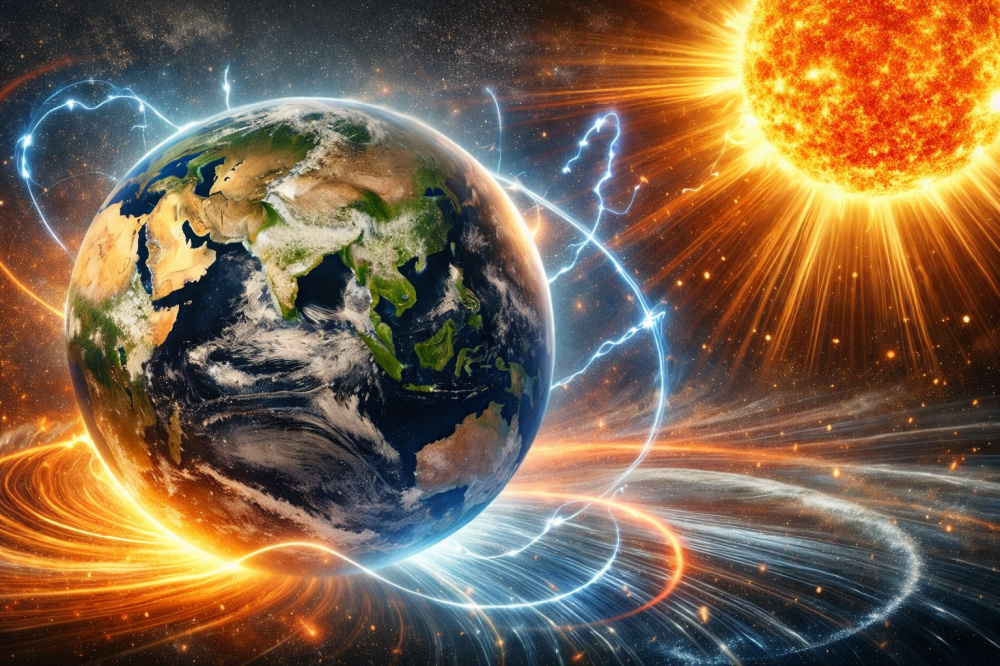
Earth is not defenseless against this solar onslaught. Our planet possesses a powerful magnetic field, generated by the convection of molten iron in its core. This field creates a protective bubble, the magnetosphere, which deflects most of the harmful solar wind and charged particles. Think of it as an invisible, cosmic umbrella shielding life from the sun's more malevolent moods.
When a CME reaches Earth, its magnetic field can interact with and compress our magnetosphere. If the CME's magnetic field is oriented southward, it can temporarily connect with Earth's northward-pointing field, allowing a surge of solar particles and energy to funnel into our magnetosphere. This influx causes the magnetosphere to reconfigure violently, generating powerful electrical currents. These currents, in turn, induce secondary currents within Earth's crust and in human-made conductors on the surface, known as Geomagnetically Induced Currents (GICs). It is these GICs that pose the most significant threat to modern infrastructure in places like Raleigh.
The silent threat to Raleigh's infrastructure
For a city like Raleigh, the immediate visual spectacle of a magnetic storm-the aurora borealis or australis-is typically reserved for extreme events and is not the primary concern. Instead, the danger lies in the invisible, insidious flow of GICs through critical infrastructure. Raleigh's advanced and interconnected society makes it particularly susceptible to these subtle yet potent disturbances.
Power grid vulnerabilities
The electrical grid is perhaps the most vulnerable system to GICs. Long, high-voltage transmission lines act like giant antennas, picking up these induced currents. Transformers, vital components that step up and step down voltage, are particularly susceptible. GICs can saturate transformer cores, causing them to overheat, experience increased reactive power demand, and potentially fail. A cascade of transformer failures across a wide area could lead to widespread and prolonged power outages, disrupting homes, businesses, and essential city services. For Raleigh, this would mean significant disruptions to its tech sector, research institutions, and daily life, potentially lasting for days or even weeks.
Duke Energy, the primary power provider for Raleigh and much of North Carolina, is acutely aware of these risks. They employ various strategies, including monitoring GIC activity and implementing operational procedures to mitigate potential damage, but a truly extreme event could still test the limits of even the most robust systems.
Communication and navigation disruption
Beyond the power grid, magnetic storms can wreak havoc on our increasingly satellite-dependent world. GPS signals, crucial for navigation, precision timing in financial transactions, and modern farming, can be degraded or lost entirely as solar particles interfere with satellite signals. Communication satellites, relaying everything from international phone calls to internet traffic, can also be affected by increased radiation and atmospheric drag. In Raleigh, where businesses and individuals rely heavily on accurate GPS and seamless communication, such disruptions could grind various sectors to a halt.
High-frequency (HF) radio communications, used by airlines for transatlantic flights, military operations, and emergency services, are also highly susceptible. During a strong storm, these frequencies can become unusable, forcing flights to be rerouted and hindering critical emergency coordination. Raleigh-Durham International Airport (RDU), a busy hub, would need to implement revised protocols, potentially delaying or diverting numerous flights.
Technological ripple effects
The modern world, and Raleigh is a prime example, is a complex tapestry of interconnected technologies. A disruption in one area inevitably creates ripple effects. Banking systems rely on precise timing from GPS. Traffic lights and public transportation systems are increasingly digitized. Critical infrastructure like water treatment plants, hospitals, and emergency dispatch centers depend on reliable power and communication. A severe magnetic storm could trigger a domino effect, leading to widespread chaos and significant economic losses for the city.
"While Raleigh may seem far removed from the dramatic auroras of polar regions, the silent surge of geomagnetic induced currents poses a very real, very modern threat to the unseen arteries of our digital society."
Raleigh's unique position and historical context
Raleigh's geographical location, while protecting it from some natural disasters, places it in an interesting relationship with magnetic storms. It's too far south to regularly witness the captivating auroral displays that characterize geomagnetic activity, yet it is by no means immune to the technological ramifications.
Beyond the visible aurora
The stunning auroras, the vibrant green, red, and purple lights dancing in the night sky, are typically seen in high-latitude regions near Earth's magnetic poles. These are caused by solar particles colliding with atoms in our atmosphere. While a truly extreme magnetic storm, like the Carrington Event of 1859, could potentially push the auroral oval far enough south for a fleeting, faint red glow to be visible in Raleigh, such events are exceedingly rare. For the Capital City, the concern shifts from atmospheric spectacle to subterranean and systemic impact.
The focus for inland cities like Raleigh must therefore remain firmly on the less visible, yet far more impactful, phenomena of GICs and communication disruptions. The absence of a visual cue makes the threat even more insidious, as residents would experience the effects without understanding their celestial origin.
Past events and lessons learned
History provides stark warnings. The Carrington Event in 1859, the most powerful known geomagnetic storm, crippled telegraph systems worldwide, sparking fires and delivering shocks to operators. Had such an event occurred today, its impact would be catastrophic for our technology-dependent world.
A more recent, albeit less severe, example is the 1989 Quebec blackout. A relatively moderate magnetic storm caused the entire Hydro-Québec power grid to collapse within minutes, leaving six million people without electricity for up to nine hours. While Raleigh's power grid is more robust and interconnected than Quebec's was at the time, the event served as a wake-up call for utilities globally. It highlighted the vulnerability of long transmission lines, especially in geologically conductive regions. North Carolina, with its varied geological landscape, must consider how these currents might propagate.
These historical events underscore the importance of continuous monitoring, research, and adaptation. Each incident, big or small, provides invaluable data for improving the resilience of critical infrastructure against future solar assaults.
Interesting facts about magnetic storms
- Solar flares can release energy equivalent to millions of 100-megaton hydrogen bombs.
- The fastest CMEs can travel from the sun to Earth in as little as 15-18 hours.
- Earth's magnetosphere extends tens of thousands of kilometers into space, providing our primary defense.
- The Space Weather Prediction Center (SWPC) in Boulder, Colorado, operated by NOAA, is the United States' official source for space weather alerts and warnings.
- A severe magnetic storm in modern times could cost the global economy trillions of dollars due to power outages, communication failures, and supply chain disruptions.
- During the Carrington Event, auroras were reportedly seen as far south as Cuba and Colombia. While unlikely, this suggests that an extreme event could theoretically produce a very faint, red aurora on the horizon for Raleigh residents.
- Some studies suggest that certain migratory animals, like birds and whales, use Earth's magnetic field for navigation, and extreme magnetic storms could potentially disrupt their internal compasses.
- The "Halloween Storms" of 2003 caused significant disruptions, including power outages in Sweden, satellite anomalies, and diversions of commercial airline flights.
Mitigation and preparedness in the capital city
While the sun's fury cannot be controlled, the impact of its geomagnetic storms on Raleigh can be significantly mitigated through proactive measures and strategic planning. Resilience is built on a foundation of foresight and continuous improvement.
Strengthening the grid
Utility companies like Duke Energy are at the forefront of protecting critical infrastructure. This involves several strategies. One is hardening transformers, either through design improvements or by installing GIC-blocking devices that prevent unwanted currents from entering the equipment. Another is implementing sophisticated monitoring systems to detect GICs in real-time, allowing operators to take preemptive actions like re-routing power or temporarily shutting down vulnerable lines before irreversible damage occurs. Furthermore, investing in spare high-voltage transformers, which can be custom-built and take months or even years to replace, is a crucial long-term strategy. The ability to quickly replace damaged components is paramount to restoring power efficiently.
Emergency response planning
The City of Raleigh's emergency management division, in collaboration with state and federal agencies, plays a vital role in preparing for and responding to all types of disasters, including those of extraterrestrial origin. This involves developing comprehensive contingency plans for widespread power outages, communication failures, and disruptions to critical services. Regular drills and simulations help to test these plans, identify weaknesses, and ensure that first responders and city officials are well-coordinated and ready to act. Public awareness campaigns also empower residents with essential knowledge, such as how to prepare an emergency kit and what steps to take during a prolonged outage.
The role of innovation and research
Raleigh's proximity to the Research Triangle Park (RTP) positions it uniquely as a hub for innovation that can contribute to space weather resilience. Universities like North Carolina State University, Duke University, and the University of North Carolina at Chapel Hill conduct cutting-edge research in electrical engineering, computer science, and atmospheric physics. This academic expertise can be leveraged to develop more resilient grid technologies, advanced space weather forecasting models, and innovative communication solutions that can withstand geomagnetic disturbances. The collaborative spirit of RTP fosters an environment where solutions to complex problems, including those originating from the sun, can be engineered and implemented.
"The greatest defense against the unpredictable fury of the sun is not a physical shield, but a tapestry woven from foresight, robust engineering, and an informed, resilient community."
A call for vigilance in the digital age
Our increasing reliance on technology for every facet of modern life makes us inherently more vulnerable to the whims of space weather. What might have been a mere curiosity or a localized disruption a century ago could today escalate into a widespread societal crisis. Raleigh, a forward-looking city, epitomizes this paradox of progress and vulnerability. The silent threat of magnetic storms demands a new kind of vigilance, a broader understanding of our place within the dynamic solar system.
The evolving threat landscape
As technology advances, so too does the potential for disruption. The sheer number of satellites orbiting Earth, the complexity of our interconnected networks, and the dependence on instantaneous digital communication all amplify the risk. A severe magnetic storm today could lead to far more than just a temporary inconvenience; it could potentially cause long-term systemic failures, impacting everything from food supply chains to financial markets. Raleigh, as a significant economic and technological center, must remain at the forefront of understanding and mitigating this evolving threat landscape.
Empowering Raleigh's residents
Individual preparedness complements the efforts of utility companies and emergency services. Residents of Raleigh should cultivate basic emergency readiness, including maintaining an emergency kit with non-perishable food, water, a battery-powered radio, and alternative light sources. Understanding how to access information during widespread outages and having a family communication plan are also critical. Most importantly, an informed public is a resilient public-one that understands the nature of the threat without succumbing to panic or misinformation.
Looking skyward with new eyes
Ultimately, the narrative of magnetic storms in Raleigh transcends mere technical vulnerabilities. It is a story about our interconnectedness, not just globally, but cosmically. It's a reminder that even in our meticulously planned urban environments, we are still very much part of a larger, often turbulent, universe. By understanding the sun's powerful influence and preparing intelligently, Raleigh can continue to thrive, resilient and ready for whatever celestial surprises the solar winds may bring.