
Nestled in the Pacific Northwest, Portland, Oregon, is renowned for its verdant landscapes, artisanal coffee culture, and an ever-present veil of soft rain. It is a city that thrives on the tangible and the immediate, its pulse set by the Willamette River and the distant majesty of Mount Hood. Yet, above this urban tapestry, an invisible drama unfolds, a cosmic ballet that, while rarely seen, can subtly touch the very fabric of its modern existence: magnetic storms.
These celestial disturbances, born from the furious heart of our sun, are far more than just breathtaking auroral displays. They represent a powerful interplay between solar energy and Earth's protective magnetic field, an interaction that holds the potential for both ethereal beauty and unforeseen disruption, even in a city as seemingly grounded as Portland. Understanding these phenomena requires looking beyond our terrestrial horizons, into the vastness of space weather, and considering how the distant rumble of a solar flare can echo through the quiet streets of the Rose City.
Understanding magnetic storms
Magnetic storms, scientifically known as geomagnetic storms, are major disturbances of Earth's magnetosphere caused by a stream of energetic particles from the sun. Our planet is constantly bathed in a gentle flow of these particles, called the solar wind, but during certain solar events, this flow intensifies dramatically, creating conditions ripe for a storm.
The sun's tumultuous ballet
The origin of these storms lies in the sun's dynamic and often volatile atmosphere. The sun is not a static ball of fire but a churning, magnetic dynamo, prone to spectacular eruptions. Two primary events on the sun contribute to geomagnetic storms: solar flares and coronal mass ejections (CMEs).
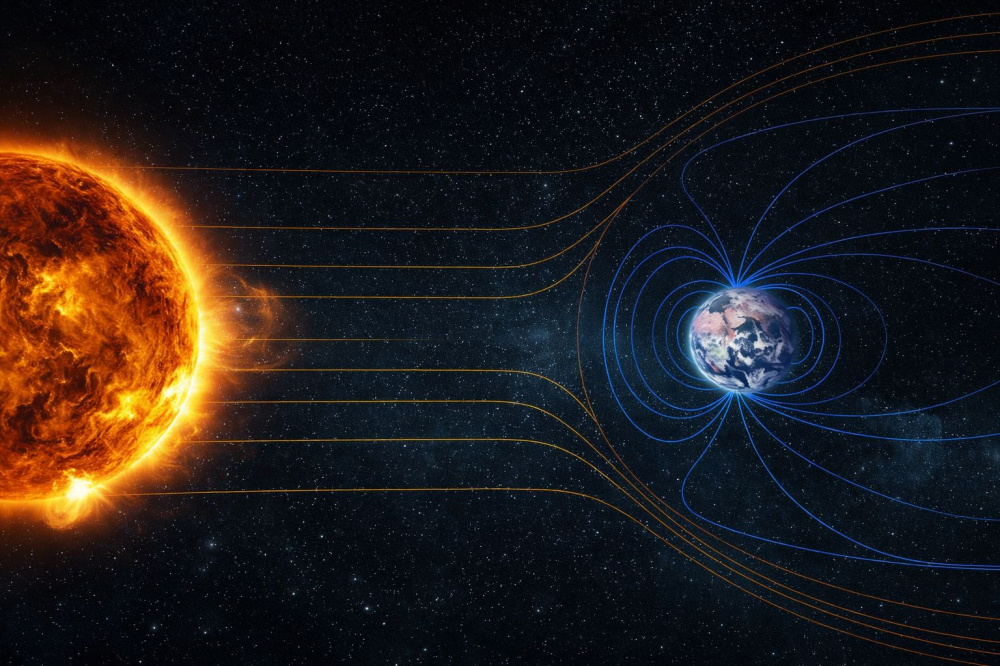
Solar flares are intense bursts of radiation erupting from the sun's surface, traveling at the speed of light. While they bombard Earth with X-rays and ultraviolet radiation that can affect our ionosphere, causing radio blackouts, it is the CMEs that are the true architects of powerful magnetic storms. CMEs are vast bubbles of superheated plasma and magnetic field, expelled from the sun at speeds ranging from a few hundred to over a thousand kilometers per second. If a CME is directed towards Earth, it can reach our planet within one to three days, carrying with it a tremendous amount of energy and magnetized material.
The sun, a constant source of life and light, also harbors the capacity for immense cosmic disruption, sending ripples through the solar system that can, at times, touch Earth with profound magnetic force.
Earth's invisible shield
Our planet possesses a magnificent defense mechanism: the magnetosphere. This is a vast, invisible magnetic bubble generated by Earth's molten iron core, extending tens of thousands of kilometers into space. It acts as a shield, deflecting the majority of harmful solar radiation and particles. When a powerful CME or high-speed solar wind stream collides with the magnetosphere, it compresses and rattles this magnetic field. The incoming solar plasma can then transfer energy, momentum, and magnetic field lines into the magnetosphere, triggering a cascade of complex interactions.
This interaction generates electrical currents in the upper atmosphere and within Earth's crust, leading to what we perceive as a geomagnetic storm. The strength of these storms is typically measured by indices like the Kp-index, which ranges from 0 (very quiet) to 9 (extremely strong). A higher Kp-index indicates a more intense storm and a greater potential for effects across a wider range of latitudes.
Potential impacts in Portland
While Portland is not situated in the high-latitude regions where auroral displays are common and storm impacts are most severe, it is still susceptible to the reach of powerful magnetic storms. The effects can range from subtle atmospheric phenomena to more tangible, though rare, technological disturbances.
Chasing the aurora in the Rose City
For many, the most enchanting manifestation of a magnetic storm is the aurora borealis, the northern lights. These shimmering curtains of light are typically seen in polar regions, where the geomagnetic field lines funnel solar particles directly into the atmosphere. However, during particularly strong geomagnetic storms (Kp-index of 7 or higher), the aurora can expand equatorward, making it visible from mid-latitude locations like Portland.
Seeing the aurora in Portland is a rare and fleeting spectacle. Conditions must be just right: a very powerful storm, clear, dark skies away from city light pollution, and a clear view to the northern horizon. When these elements align, faint glows of green or even pink might dance above the Cascade foothills, offering a celestial reward to patient stargazers. Such an event transforms the familiar Portland sky into a canvas for cosmic artistry, a reminder of the unseen forces at play.
The silent hum of disruption
Beyond the visual spectacle, magnetic storms can have more subtle, yet significant, impacts on modern infrastructure, even at Portland's latitude. These are often not immediately apparent but are critical considerations for operators of various systems.
One primary concern is the effect on the power grid. Geomagnetically induced currents (GICs) can flow through long conductors like power transmission lines and pipelines. While Portland's grid might not experience the direct transformer damage seen in high-latitude events, GICs can cause saturation in transformers, leading to increased reactive power consumption, voltage fluctuations, and potential system instability. Such disruptions could strain an already complex grid, leading to localized outages or more widespread blackouts, impacting homes, businesses, and essential services across the metropolitan area.
Another area of vulnerability is satellite-based technologies. GPS signals, essential for navigation, timing, and synchronization across numerous industries, can be disrupted by fluctuations in the ionosphere caused by magnetic storms. These disruptions can lead to errors in positioning, signal loss, and even temporary outages for precise GPS applications. Imagine the implications for ride-sharing services, package deliveries, or even agricultural machinery that relies on centimeter-level accuracy in the fertile Willamette Valley.
High-frequency (HF) radio communications, used by aviation, emergency services, and maritime operations, can also be severely impacted. The same ionospheric disturbances that affect GPS can cause signals to scatter, absorb, or fade, leading to communication blackouts. Even low-frequency radio waves, used for submarine communication, can be affected. These silent disruptions underscore the interconnectedness of our technological society with the ethereal environment of space.
The subtle whisper of a distant solar event can reverberate through the circuits and signals of our technologically dependent world, making the invisible, ironically, quite tangible.
Infrastructure vulnerabilities
The increasing reliance on interconnected, sensitive technologies makes cities like Portland more vulnerable than ever to space weather events. Older infrastructure, not designed with geomagnetic storms in mind, presents its own set of challenges. Modern systems, while often more robust, are also more complex, making cascading failures a potential risk.
For Portland, with its blend of urban development and critical infrastructure, assessing and mitigating these vulnerabilities is an ongoing task. This involves not only understanding the physical impacts on power lines and transformers but also preparing for potential disruptions to communication networks, air traffic control, and financial systems that rely on precise timing signals.
Interesting facts about magnetic storms and their reach
- The speed of cosmic energy
Coronal Mass Ejections (CMEs) can travel from the sun to Earth in as little as 15 to 18 hours for the fastest events, though typical transit times are between 1 to 3 days. Imagine a force unleashed millions of miles away reaching us faster than a cross-country flight.
- Power unleashed
A single solar flare can release as much energy as millions of hydrogen bombs exploding simultaneously. This immense energy, when directed at Earth, is what drives the most intense magnetic storms.
- The Carrington Event
In 1859, the most powerful geomagnetic storm on record, known as the Carrington Event, caused telegraph systems worldwide to fail, sparking fires, and producing auroras visible in tropical latitudes like Cuba and Hawaii. If such an event were to occur today, its impact on our globally interconnected, technology-dependent society would be catastrophic, far beyond what Portland has ever experienced.
- Colors of the aurora
The specific colors of the aurora (greens, reds, blues, purples) are determined by the type of gas atoms in Earth's atmosphere that are excited by the solar particles and the altitude at which these collisions occur. Oxygen atoms usually emit green light at lower altitudes and red light at higher altitudes, while nitrogen atoms produce blue or purple hues.
- Subtle compass shifts
Even mild geomagnetic storms can cause slight, transient fluctuations in Earth's magnetic field, enough to affect sensitive compasses, though these are typically too minor to impact modern navigation systems significantly.
- Geomagnetically induced currents (GICs)
These ground currents, flowing through conductors like pipelines and power lines during a storm, are driven by the rapid changes in Earth's magnetic field. They are an invisible threat, silently stressing infrastructure without direct contact.
- Biological impacts
While largely unproven for humans, some studies suggest that strong geomagnetic activity might subtly influence animal migration patterns (like birds and whales that use Earth's magnetic field for navigation) or even affect human sleep patterns or mood, though this remains an area of active research.
Monitoring and prediction
The ability to monitor and predict space weather events is crucial for mitigating their potential impacts. Just as terrestrial meteorologists forecast rain or sunshine, space weather forecasters peer into the sun to anticipate geomagnetic storms.
Celestial meteorologists
Agencies like the National Oceanic and Atmospheric Administration (NOAA) Space Weather Prediction Center (SWPC) in the US, along with international partners, constantly monitor the sun. They use a network of ground-based observatories and space-based satellites to detect solar flares, CMEs, and changes in the solar wind.
Satellites like the Solar and Heliospheric Observatory (SOHO) and the Solar Dynamics Observatory (SDO) provide continuous, high-resolution images of the sun's surface and corona. The Advanced Composition Explorer (ACE) satellite, positioned at the L1 Lagrange point between the Earth and the sun, acts as an early warning system, detecting incoming solar wind and CME shockwaves about 30 to 60 minutes before they reach Earth's magnetosphere. This crucial lead time allows power grid operators, satellite companies, and other critical infrastructure managers to take precautionary measures.
Forecasts issued by the SWPC range from short-term warnings for immediate storm impacts to long-term outlooks based on the sun's 11-year activity cycle. These predictions help Portland and other communities prepare, though the precise timing and intensity of geomagnetic storm impacts can still be challenging to forecast with absolute certainty.
Mitigation and preparedness
While we cannot prevent magnetic storms, we can take steps to mitigate their effects. For a city like Portland, preparedness involves a multi-faceted approach.
Protecting our technological tapestry
For power grids, this means implementing protective measures like installing neutral-blocking devices in transformers, enhancing monitoring systems for GICs, and having contingency plans for rerouting power or shedding load during severe events. Regular stress tests and vulnerability assessments help identify weak points in the system. The Pacific Northwest, with its extensive hydropower and long transmission lines, has a vested interest in understanding and preparing for these phenomena.
In the realm of communications and navigation, mitigation involves developing robust, redundant systems that can operate even with degraded GPS signals or HF radio outages. This includes exploring alternative navigation methods and ensuring that emergency communication channels are resilient to space weather disruptions. For Portland, this might translate into ensuring that local emergency services have access to satellite-independent communication systems and that critical infrastructure operators have clear protocols for responding to space weather alerts.
Public awareness also plays a role. Educating residents about the potential for aurora visibility, but also about the more subtle risks to technology, can foster a more informed and prepared community. While the immediate threat to daily life in Portland from a typical magnetic storm is low, a stronger, rarer event necessitates a proactive stance. The invisible cosmic forces, though distant, demand our respect and attention, reminding us that even in our modern, urbanized world, we remain inextricably linked to the sun and the dynamic universe it inhabits.