
Magnetic storms and the heartland
In the vast expanse of America's heartland, where the Platte River meanders through fertile plains and the urban tapestry of Omaha, Nebraska, unfolds against an often serene sky, concerns about cosmic phenomena might seem distant. Yet, beneath the tranquil surface of daily life, an invisible ballet of forces constantly plays out, influenced by the distant turbulence of our sun. Magnetic storms, or geomagnetic storms, are not solely the domain of polar regions or high-tech coastal centers. They are a global phenomenon, capable of extending their reach deep into continental interiors, challenging our preconceived notions of vulnerability and resilience.
Omaha, a city celebrated for its robust agricultural ties, burgeoning tech sector, and significant transportation infrastructure, exists within a complex electromagnetic environment. While it rarely experiences the dazzling auroral displays that captivate observers closer to the Earth’s magnetic poles, it remains susceptible to the underlying magnetic disturbances that orchestrate such phenomena. These disturbances, originating from violent eruptions on the sun's surface, send waves of charged particles hurtling towards Earth, interacting with our planet's protective magnetic shield. Understanding this interplay, particularly in a seemingly unaffected locale like Omaha, offers a crucial perspective on modern infrastructure's inherent fragility and the unseen threats that linger just beyond our perception.
Decoding the solar tempest
The genesis of a magnetic storm lies millions of miles away, within the incandescent crucible of the sun. Our star, a dynamic and volatile entity, periodically ejects colossal bursts of energy and matter into space. These events primarily manifest as solar flares, intense bursts of radiation, and coronal mass ejections (CMEs), which are vast clouds of magnetized plasma expelled from the sun's corona. While solar flares travel at the speed of light, their direct impact on Earth is mostly limited to radio blackouts. CMEs, however, are the primary architects of geomagnetic storms, hurtling through interplanetary space at speeds ranging from a few hundred to over two thousand kilometers per second.
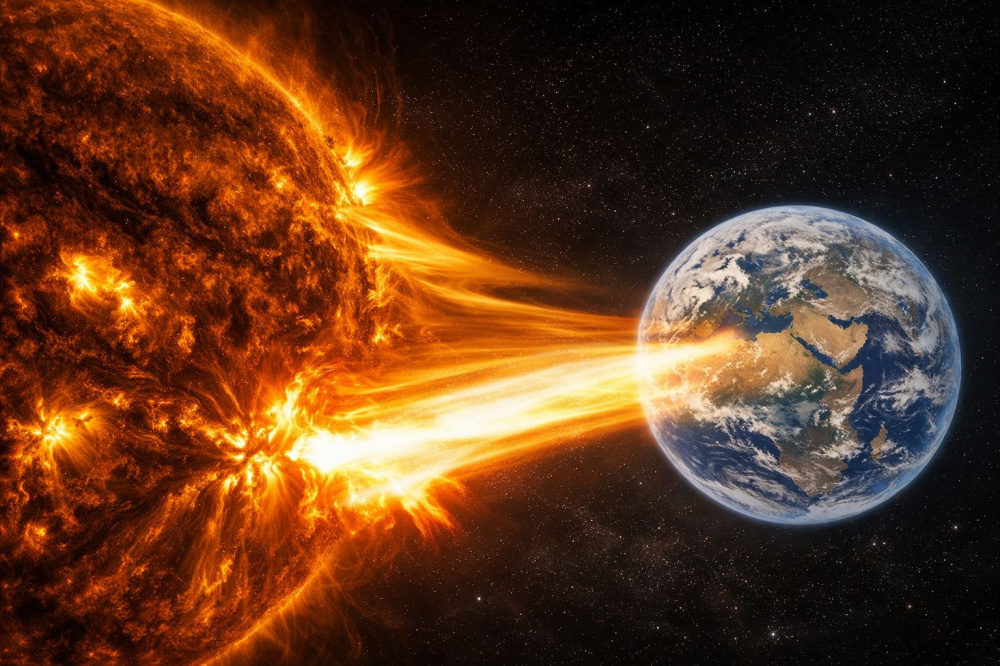
When one of these magnetized plasma clouds reaches Earth, typically within one to three days, it collides with our planet's magnetosphere, the protective bubble generated by Earth's own magnetic field. This collision can compress and reconfigure the magnetosphere, allowing solar wind particles to penetrate deeper into the atmosphere, especially at the poles. The interaction triggers a cascade of effects, generating powerful electrical currents in the upper atmosphere and inducing geomagnetically induced currents (GICs) within the Earth's crust. The severity of these storms is often quantified by the Kp-index, a scale ranging from 0 to 9, where higher numbers indicate more intense geomagnetic activity. Even a moderate Kp-index can have far-reaching implications, extending their influence far beyond the vivid green and purple curtains of the aurora borealis.
Omaha's unique geophysical vulnerability
Located at approximately 41 degrees North geographic latitude, Omaha might seem geographically immune to the more dramatic manifestations of space weather. However, geomagnetic latitude, which is based on the Earth’s magnetic poles rather than its rotational axis, paints a different picture. Omaha's geomagnetic latitude is significantly higher, placing it in a zone where the effects of strong geomagnetic storms can still be pronounced, even if the visual spectacle of the aurora is rare. During exceptionally powerful storms, the auroral oval, which typically encircles the magnetic poles, can expand dramatically, occasionally bringing the Northern Lights into view even as far south as Nebraska.
Beyond the potential for a fleeting sky show, Omaha's inland geology plays a critical role in its susceptibility to GICs. The Earth's crust is not uniformly conductive. Regions with highly conductive bedrock, such as those rich in saline aquifers or certain mineral deposits, can amplify the effects of induced currents, allowing them to travel more easily and accumulate. While the specific geological profile beneath Omaha and the surrounding plains of Nebraska features a mix of sedimentary rocks, the presence of various conductive layers can influence how GICs propagate. These currents seek the path of least resistance, often flowing through long conductors like power lines and pipelines, turning them into unintended receivers of cosmic energy.
Infrastructure at risk in the heartland
The modern world is interwoven with an intricate network of interconnected technologies, many of which are sensitive to electromagnetic disturbances. For a city like Omaha, serving as an economic engine for the Midwest and a vital logistical hub, the potential impacts of a severe magnetic storm are multifaceted and concerning. The most significant threat looms over the electrical power grid, a complex system of generation, transmission, and distribution that keeps homes lit and industries humming.
Power grid fragility
Both Omaha Public Power District (OPPD) and Nebraska Public Power District (NPPD) manage extensive power grids that serve millions across the state. GICs, driven by geomagnetic storms, can flow into these grids through neutral-to-ground connections in transformers. These parasitic currents are not what the transformers are designed to handle. They can cause half-cycle saturation, leading to increased reactive power demand, voltage fluctuations, and overheating. In extreme cases, transformers can be permanently damaged or fail outright, potentially triggering cascading blackouts. The prolonged loss of power, especially in a region prone to temperature extremes, would have devastating consequences for residential areas, businesses, and critical services like hospitals and water treatment plants.
Communication disruptions
Modern communication systems, from satellite navigation (GPS) to radio transmissions, are also vulnerable. Geomagnetic storms can disrupt the ionosphere, the electrically charged layer of Earth's upper atmosphere through which radio signals travel. This can lead to signal degradation, loss of lock for GPS satellites, and interference with high-frequency (HF) radio communications used by aviation, emergency services, and maritime operations. In a state where precision agriculture heavily relies on GPS for planting, irrigation, and harvesting, even temporary disruptions could lead to significant economic losses and operational inefficiencies. Air traffic control at Omaha Eppley Airfield, like all modern airports, depends on reliable communication and navigation systems, making such disruptions a serious safety concern.
Pipeline integrity
Nebraska is crisscrossed by numerous pipelines transporting oil, natural gas, and other vital commodities. These long metallic structures act as giant antennas, susceptible to GICs that can accelerate electrochemical corrosion. While pipelines are typically protected by cathodic protection systems, strong GICs can overwhelm these defenses, leading to localized corrosion and potential breaches. Given the environmental and economic ramifications of pipeline failures, maintaining their integrity during periods of geomagnetic disturbance is paramount.
Other electronic systems
While less direct, the ripple effects can extend to a myriad of other electronic systems. Satellite-based internet services, vital for many rural areas around Omaha, could experience outages. Even seemingly robust systems could face challenges if the foundational power and communication infrastructures are compromised. The interconnectedness of modern society means that a disturbance in one area can quickly propagate, leading to unforeseen complications.
Interesting facts about magnetic storms and Omaha
- Omaha's geomagnetic latitude is roughly 52 degrees North, significantly higher than its geographic latitude of 41 degrees North. This places it closer to the magnetic pole in terms of how it experiences space weather phenomena.
- The Carrington Event of 1859, the most powerful geomagnetic storm on record, caused telegraph systems to fail, spark, and even operate without battery power. If such an event were to occur today, Omaha would face widespread and prolonged infrastructure damage.
- While rare, auroral displays have been observed in Nebraska during exceptionally strong geomagnetic storms, often appearing as a faint reddish glow low on the northern horizon rather than the vibrant, dancing lights seen at higher latitudes.
- The warning time for a CME impacting Earth is typically between 12 hours and 3 days, providing a crucial but often narrow window for utilities and critical infrastructure operators in Omaha to prepare.
- The energy released during a major solar flare can be equivalent to millions of hydrogen bombs, showcasing the immense power driving these space weather events.
- Earth's magnetosphere deflects most of the solar wind, but during a magnetic storm, it acts more like a leaky shield, allowing energy and particles to funnel into the atmosphere.
Historical echoes and future preparedness
While Omaha has not been directly hit by a Carrington-level event in the modern era, historical records and global incidents offer stark reminders of what could be. The Quebec blackout of 1989, caused by a relatively moderate geomagnetic storm, plunged millions into darkness for hours, leading to significant economic disruption and showcasing the vulnerability of modern power grids. Although Quebec is at a higher geomagnetic latitude than Omaha, the incident underscored that such vulnerabilities are not confined to the Arctic Circle.
The lessons from these events have spurred critical infrastructure operators, including those serving the Omaha metropolitan area, to enhance their preparedness. Utilities like OPPD and NPPD engage in ongoing efforts to mitigate the risks associated with GICs. These measures include installing GIC-monitoring equipment on key transformers, developing operational procedures to reduce grid load during severe storm warnings, and exploring hardening solutions such as installing series capacitors to block GIC flow. Furthermore, regular drills and simulations are conducted to ensure that emergency response teams are ready to address potential outages and manage the restoration process efficiently.
Beyond the utilities, governmental agencies at federal, state, and local levels are increasingly integrating space weather phenomena into their emergency preparedness plans. FEMA, in conjunction with state emergency management agencies in Nebraska, works to raise awareness and coordinate responses for a wide array of natural and man-made disasters, including those originating from space. Public awareness, though still relatively low for geomagnetic storms compared to more terrestrial threats like tornadoes or blizzards, is gradually improving as the scientific community and policymakers emphasize the importance of understanding these cosmic influences.
A rare celestial dance over the plains
Imagine a clear, inky night over the expansive fields surrounding Omaha, where the distant city lights create a gentle glow on the horizon. On an extraordinary occasion, as an exceptionally powerful geomagnetic storm rages overhead, a faint, ethereal luminescence begins to paint the northern sky. It might start as a subtle green hue, almost imperceptible against the backdrop of distant stars, slowly deepening and perhaps acquiring hints of crimson along its upper edges. This isn't the vibrant, pulsating spectacle witnessed in Alaska or Scandinavia, but a more understated, yet equally profound, manifestation of the sun's distant fury.
For residents of Omaha, accustomed to vast, star-filled nights but rarely to aurora, such an event would be both wondrous and a quiet reminder of the powerful, unseen forces at play in our universe. It underscores that even in the heart of the continent, far from the traditional epicenters of space weather impacts, Earth remains intimately connected to the dynamic ballet of cosmic energy. The fleeting beauty of such a rare auroral display over the Nebraska plains would serve as a visible testament to the very same magnetic turbulence that simultaneously tests the resilience of our power lines, communication networks, and the intricate technological web that supports modern life.